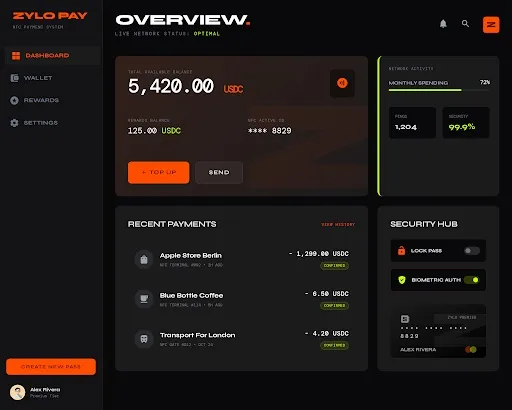
ZyloPay is an on-chain payment network built on the Monad blockchain. Consumers pay merchants from an Apple Wallet or Google Wallet pass, with gasless EIP-712-signed payments relayed on their behalf, and merchants receive USDC directly to their wallet. The monorepo covers the marketing site, merchant dashboard, payer app, admin portal, a World App mini app, a native Android POS terminal, the Solidity settlement contract and developer docs.
The problem
ZyloPay set out to make USDC work at a shop counter with no wallet app to open and no gas to hold. The payment instrument is a pass in the payer’s Apple Wallet or Google Wallet.
Payers needed to sign up with email or Google and get a wallet without crypto experience. Merchants needed a counter-top terminal that confirms a payment within two seconds and sends USDC to their own wallet. Developers needed an API to drive terminals.
What we built
A payer signs one spending approval in the payer app and adds a ZyloPay pass to their phone’s wallet. At the counter, the cashier enters an amount on the Android POS app and the payer taps. Google Wallet passes pay over NFC through Google Smart Tap. Apple Wallet passes pay by QR until Apple approves NFC for the pass type. Payments above a set amount wait for the payer to confirm on their phone.
Underneath, the NestJS API resolves the tapped credential to its pass, checks limits and fraud rules, claims the session atomically and sends the settlement from a relayer that pays the gas. ZyloPaySettlement, a UUPS-upgradeable Solidity contract on Monad mainnet, pulls the USDC and splits the fees. A public API with test and live keys, signed webhooks and Node and Python SDKs lets merchants drive terminals from their own systems.
How we built it
The repo started from the Spec Kit template. Each of its three feature specs has a spec, plan, data model, API contracts, task list and design boards. Bigger decisions go to the owner as RFCs, five so far.
Agents did most of the typing: 766 of the 874 commits carry a Claude Code co-author. In November, Obvious Autobuild agents worked from 21 task specs in their own sandboxes and opened 18 PRs. The money path, the contract and auth were deliberately kept out of their waves.
AGENTS.md says agents never merge their own PRs and never deploy. A person merged 133 of the 134 merged PRs. Before a merge, scripts/ci-local.sh runs the same 25 jobs as the GitHub workflow: API unit, integration and end-to-end suites, chain tests against a local Anvil node, Foundry contract tests, Android POS tests and production web builds. PRs that change UI attach screenshots.
What was hard
Speaking Google Smart Tap. The POS reads Google Wallet passes with Smart Tap v2.1, and the handshake has to be right byte for byte. One day in March took 14 commits to get the NEGOTIATE structure, HKDF parameters, mobile nonce and key version right. Google Wallet doesn’t reliably sync NFC pass updates, so the NFC value stays fixed and a rotating token lives in the QR code.
Never sending a payment twice. Monad’s RPC treats “pending” like “latest”, so two taps in one block got the same relayer nonce and all but one failed. Nonces now come from one Postgres counter shared by both API machines. Each transaction is signed locally, so its hash is known before its single send. Any unclear answer is marked unconfirmed and left to a reconciler. Nothing is retried blindly.
One API, two networks. A single API serves mainnet and testnet, and both contracts number merchants from 1000, so every merchant and order lookup carries the network. Passes, terminals and keys are each bound to one. The API runs on two machines without sticky sessions, so tokens, nonces and job state live in Postgres.
By the numbers
- 874 commits on main since March 22, 2026
- Settlement contract live on Monad mainnet about 42 hours after the first commit
- 134 merged pull requests since September 26: 116 opened by a person, 18 by Obvious Autobuild
- 133 of the 134 merged by a person
- 9 apps and 6 shared packages
- 352 test files across TypeScript, Kotlin, Solidity and Python
- 3 feature specs, 21 task specs and 5 RFCs
Where it is now
The marketing site, payer app, merchant dashboard and developer docs are live, and the API is up on Fly. The mainnet contract reports implementation version 2, which pays payer cashback inside the payment transaction. Public API v1 shipped on September 28, with AI agent payments. November added monthly merchant statements, the Python SDK, and Spanish and Portuguese in the mini app.
Next: NFC for Apple Wallet passes once Apple approves it, store review for the payer mobile app, and finishing Clover terminal support, which needs a test device.