Writing / Process ·
"Shipped" meant "the code exists." Here is what we changed.
An audit of our referee app found features that were written, marked shipped and never connected. What we found, and the rules we added afterwards.
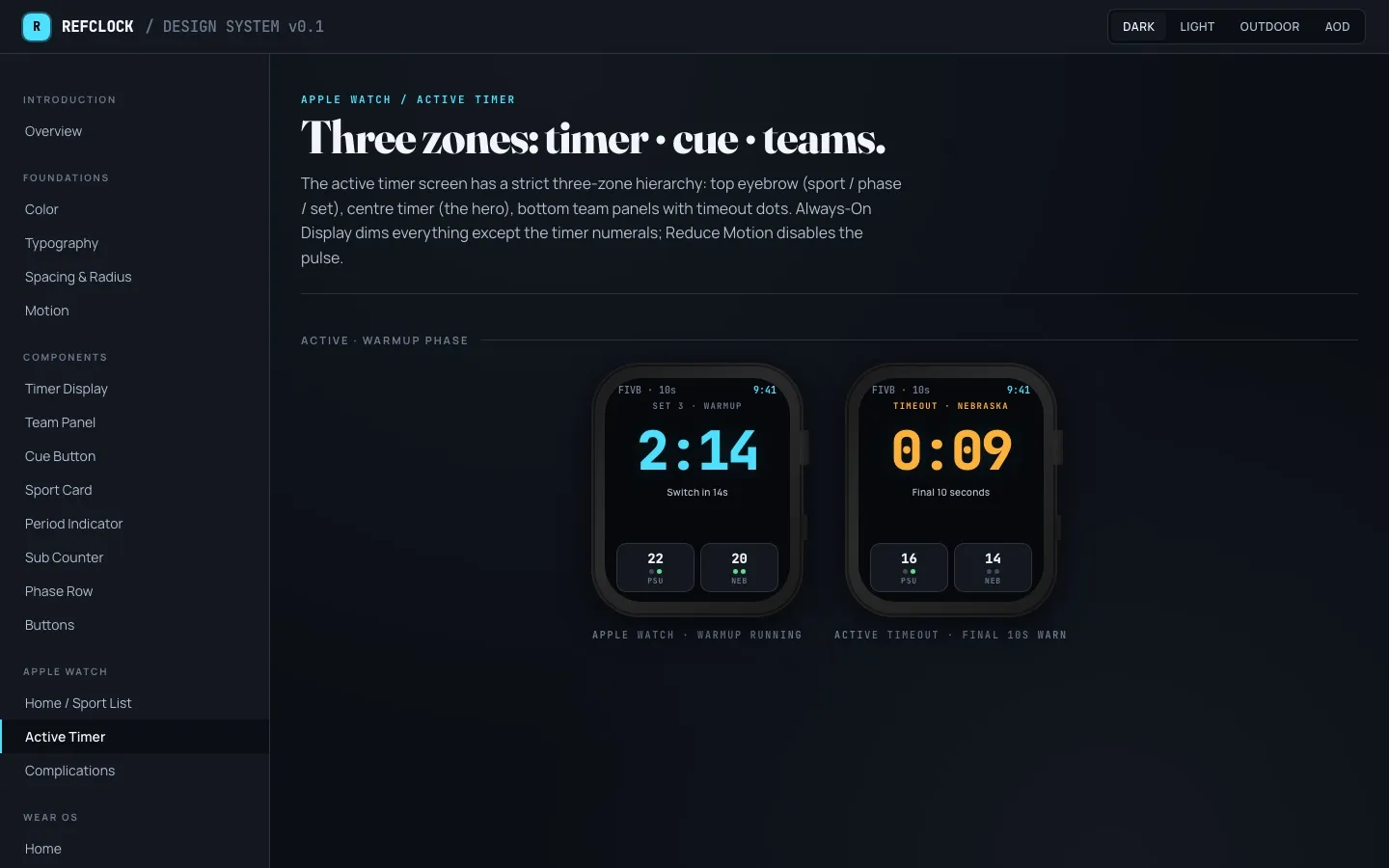
RefClock is an officiating instrument for referees. One Kotlin Multiplatform engine runs on Apple Watch, Wear OS, iPhone and Android, and the status table in its README listed every release as shipped.
On September 7, 2026 we audited that table against the running apps. Several rows had no working path:
- The phone’s rules engine had no caller, so the release’s own acceptance scenario could not pass.
- The tournament pre-match card was drawn on both watches and never given any data.
- The screen for adjusting rule parameters had no route to it, and the engine ignored the values anyway.
- The Live Activity’s buttons posted into an App Group that no target owned.
- The watch-face complications read a key that nothing wrote, so they showed a placeholder for the whole match.
- The repository held fourteen translated locale bundles. The phone loaded seven of them and the watches five.
Every one of these had code, and the status table called it shipped. None of them worked for a referee.
The status table: every row shippedThe audit: written, never connectedAfter the fix: connected, and a test guards it
Why it happened
Agents are very good at producing the piece they were asked for. A task that says “add complications” gets complications. Whether anything feeds them is a different task, and if nobody writes that task, nobody does it. People do this too. Agents just do it faster, and at a volume where a human reviewer reading diffs won’t notice what is missing.
What we changed
The README now says plainly that “shipped” has meant “the code exists” more than once. The agent instructions tell the next agent to treat the word that way until it has followed the path itself.
Each fix from the audit came with a test that fails if the wiring is removed. The watch face, for example, now has a test that checks the app writes the snapshot the complications read. That is what makes the fix last: the next agent that refactors that bridge can’t silently disconnect it again.
The “Known Product Gaps” section of the agent instructions now names the defect class, “built, tested, and never connected”, and the three checks that guard against it: a route-reachability test, a translation-coverage test and a CI check on the watch’s string catalog. It also lists what is still open, and it carries one rule: when you add a surface, add the thing that reaches it in the same change.
What it means for client work
When we hand over a product, the evidence comes with it: which checks ran, what they covered, and what is still open. If something is only written, we say it’s only written.