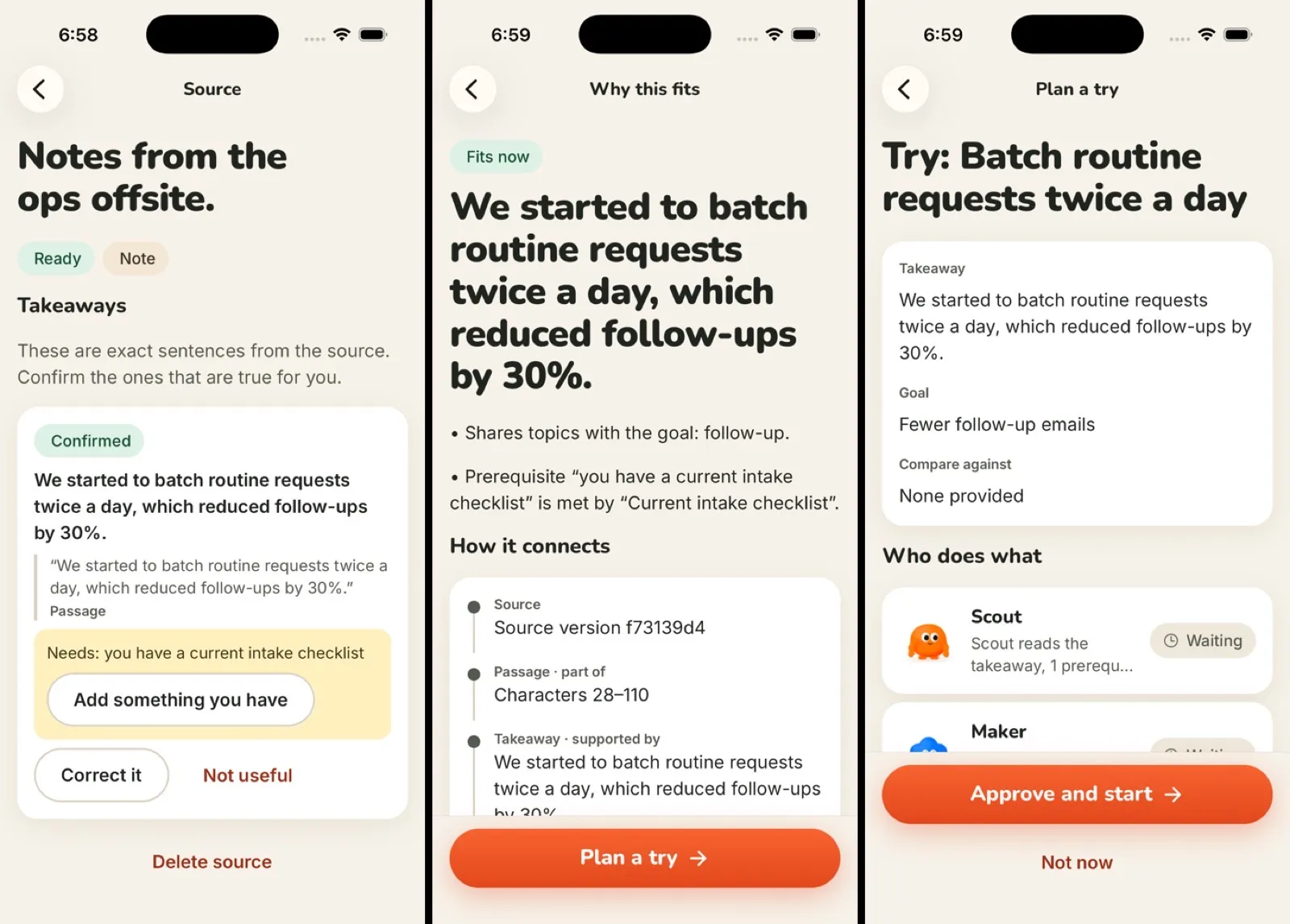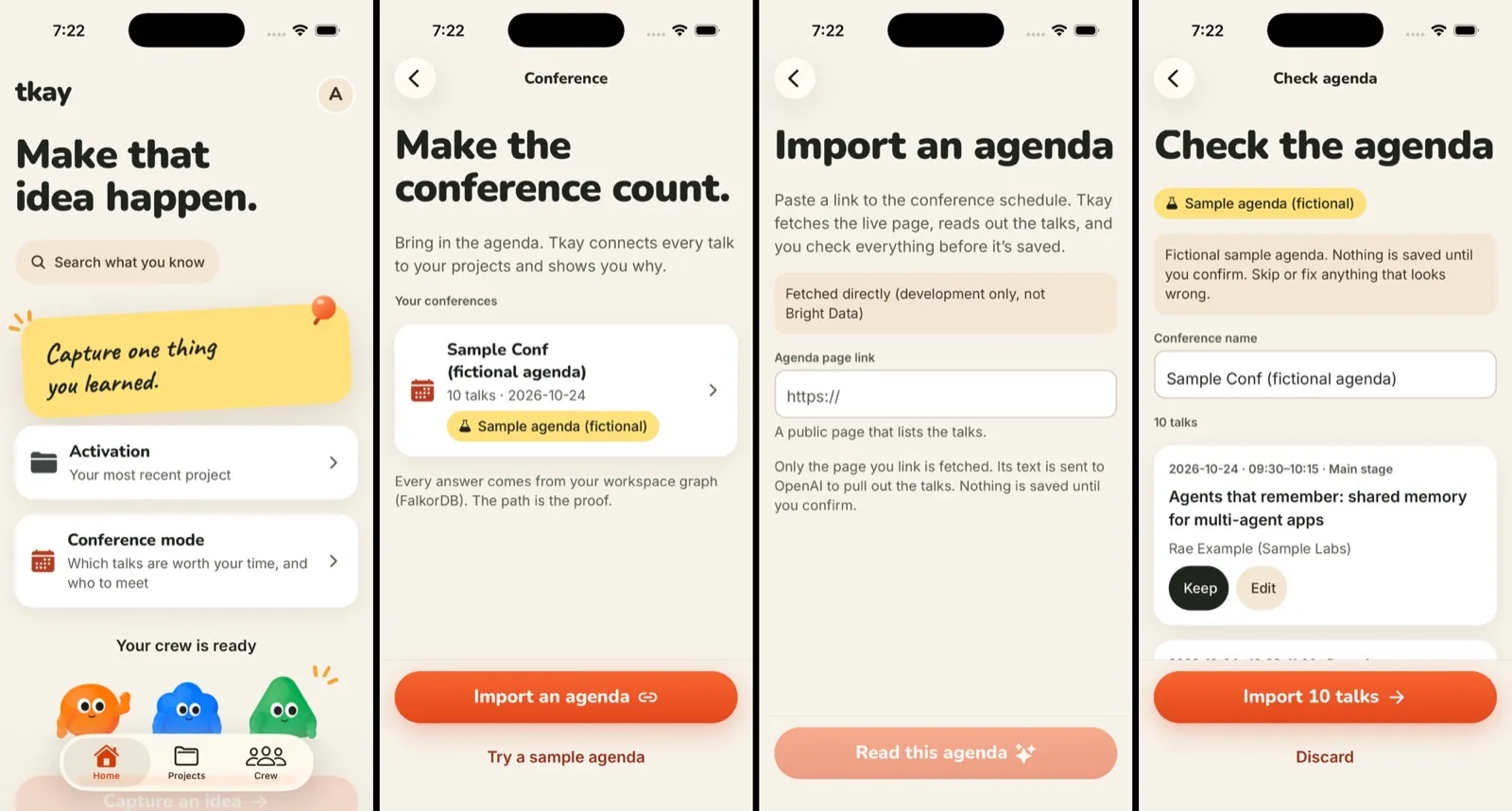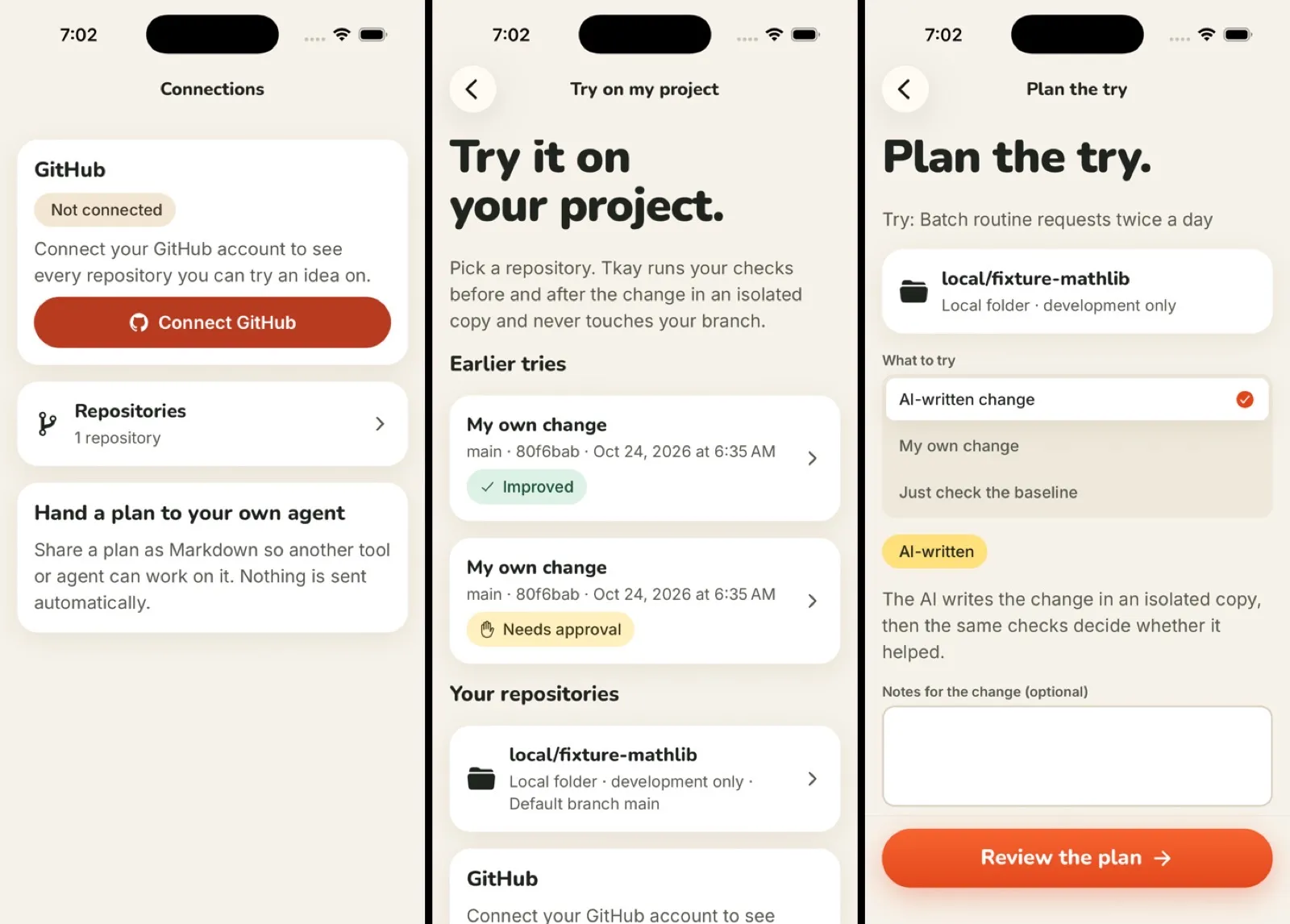
Tkay is a mobile app for turning takeaways into action: capture something you learned, connect it to your real projects, and let a small crew (Scout, Maker and Checker) try it safely before you keep what works. Scout finds the connection, Maker makes the first draft and Checker checks what changed, with every plan approved before it runs. It can also run a change against a connected GitHub repository in an isolated copy and compare checks before and after. The iOS app is in beta on TestFlight, with a 1:45 demo video from a hackathon.
The problem
People come back from talks and conferences with good ideas and rarely use them. The product requirements name the gap: attendees collect ideas “without enough time, project context, implementation help or evaluation discipline to use them.”
The PRD is written for engineers and non-engineers alike. It doesn’t claim notes or coding agents are new. It asks for the loop between them: take an idea to a tried change, compare it with the starting point, and say plainly when the answer is “we don’t know yet.”
What we built
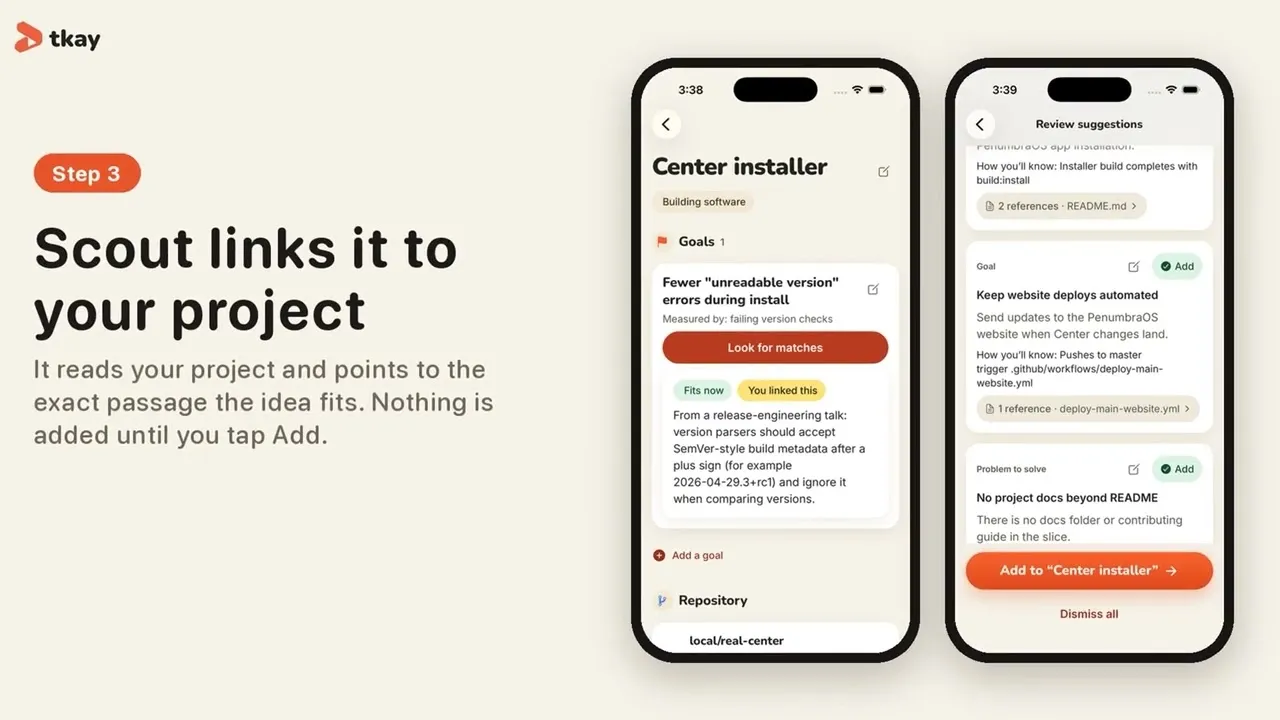
You capture something you learned as a note, link, photo, PDF or voice note. It’s saved on the phone first, encrypted, even offline. Scout connects it to one of your projects and explains why it fits. You approve a plan with a spending limit before anything runs. Maker builds a small try, like a rewrite or a code change on a branch. Checker compares it with where you started and lists what is still unknown.
Conference mode ranks a conference’s talks by how they connect to your projects. With GitHub connected, Tkay runs your checks on an isolated copy before and after the change, and opens a draft pull request only when you approve it.
Underneath, a Hono API keeps each workspace’s data in Postgres behind row-level security. A Temporal worker runs the crew. FalkorDB holds a graph projection, fed from a transactional outbox, that answers “why this fits.”
How we built it
The work started from a PRD and a 15-document build pack covering experience, architecture, security and release acceptance. A progress log marks every item as implemented, tested, verified on a simulator or device, or blocked, and names the command that proved it. Decisions are recorded in 33 ADRs.
AGENTS.md gives every coding agent the same rules, including the areas (auth, consent, billing, deploys) that need owner approval. The October build was done with Claude Code. In November, Obvious Autobuild agents worked from task specs in their own sandboxes and opened 42 of the 89 merged PRs. A person made every merge but one, after re-running the tests on current main.
CI runs typecheck, lint, unit tests and the website build on every PR, plus an integration job against real Postgres and FalkorDB. Mobile tests fail the build on unlabeled controls and touch targets under 44 points. Two UX audits walked the app in dark mode, at the largest text size, and in Arabic and Japanese.
What was hard
Running someone else’s code safely. A repository try runs the project’s install and tests twice. Railway containers couldn’t isolate that code from the worker’s credentials, so hosted checks run in fresh Daytona sandboxes with no credentials and the network blocked. On our current tier a few essential services stay reachable, and every run’s report says so.
Trusting the right GitHub account. An early version trusted an installation ID sent by the app, which we caught before the beta. Now each member links their own GitHub account, Tkay keeps a verified snapshot of what it can reach, and draft PRs need that person’s own push access. No GitHub user tokens are stored.
Keeping the graph honest. The graph is a projection of Postgres. Each write adds a sequenced outbox event, the projector applies them strictly in order, and reads wait for it to catch up. We also found that FalkorDB 4.22 treats exists() on a pattern as a null check, so the queries use pattern comprehension instead.
By the numbers
- 89 merged pull requests: 45 opened by a person, 42 by Obvious Autobuild, 2 by Dependabot
- 88 of the 89 merged by a person
- 90 commits on main since October 24, 2026
- About 15 hours from the first commit to the first iOS build going to TestFlight review
- 122 test files; 519 unit tests passing in the latest CI run, integration suites not included
- 9 workspace packages: 2 apps, 4 services and 3 shared libraries
- 14 database migrations and 10 app languages
Where it is now
The iOS app is in beta on TestFlight. tkay.app is live with a help guide and FAQ, and api.tkay.app runs a Railway staging environment on the latest main commit. November’s work hardened the core, from idempotent creates to crash-recovery tests.
Next on the backlog: a TestFlight build for a public group, an Android release on Google Play, email sign-in, and native-speaker review of the translated consent text.
Plays from YouTube, which may store data on your device. Cookie Notice