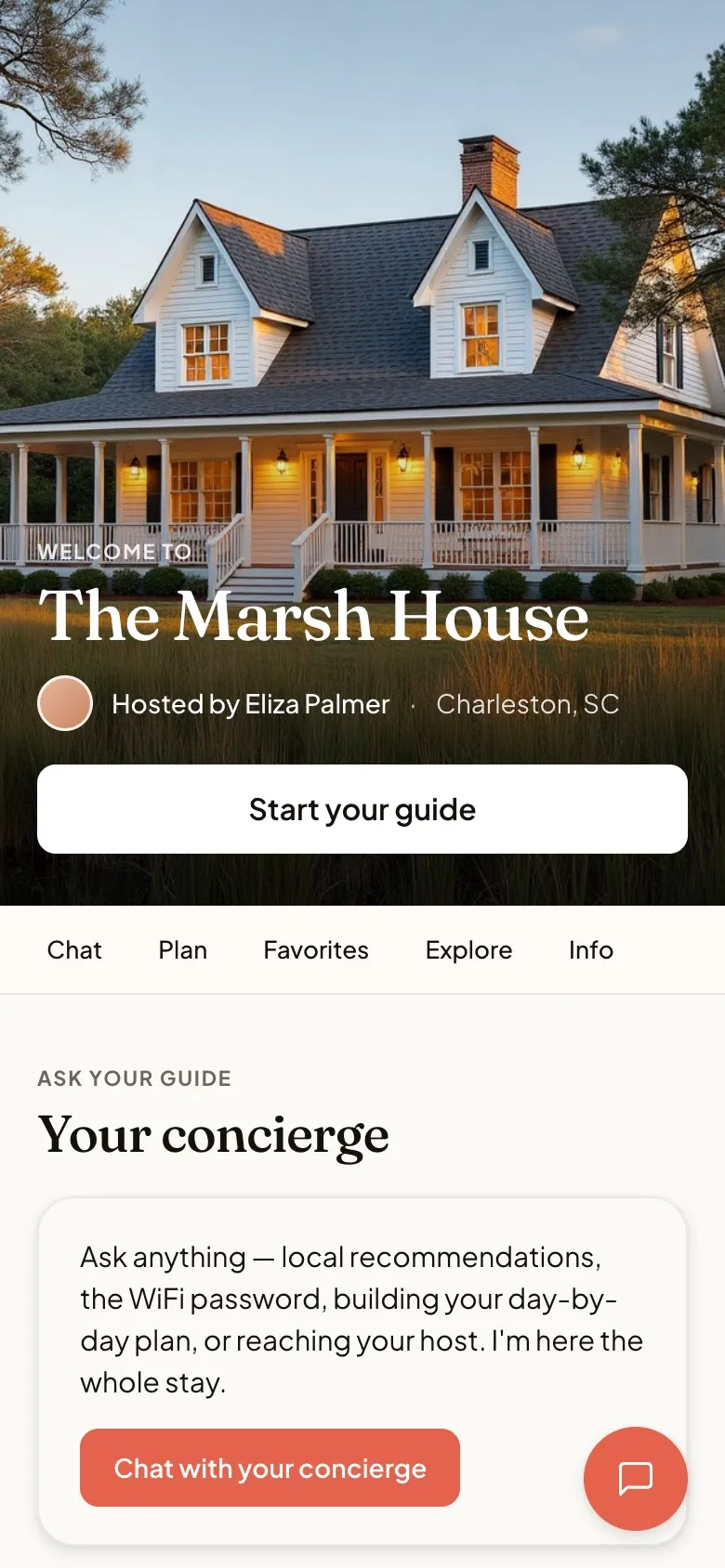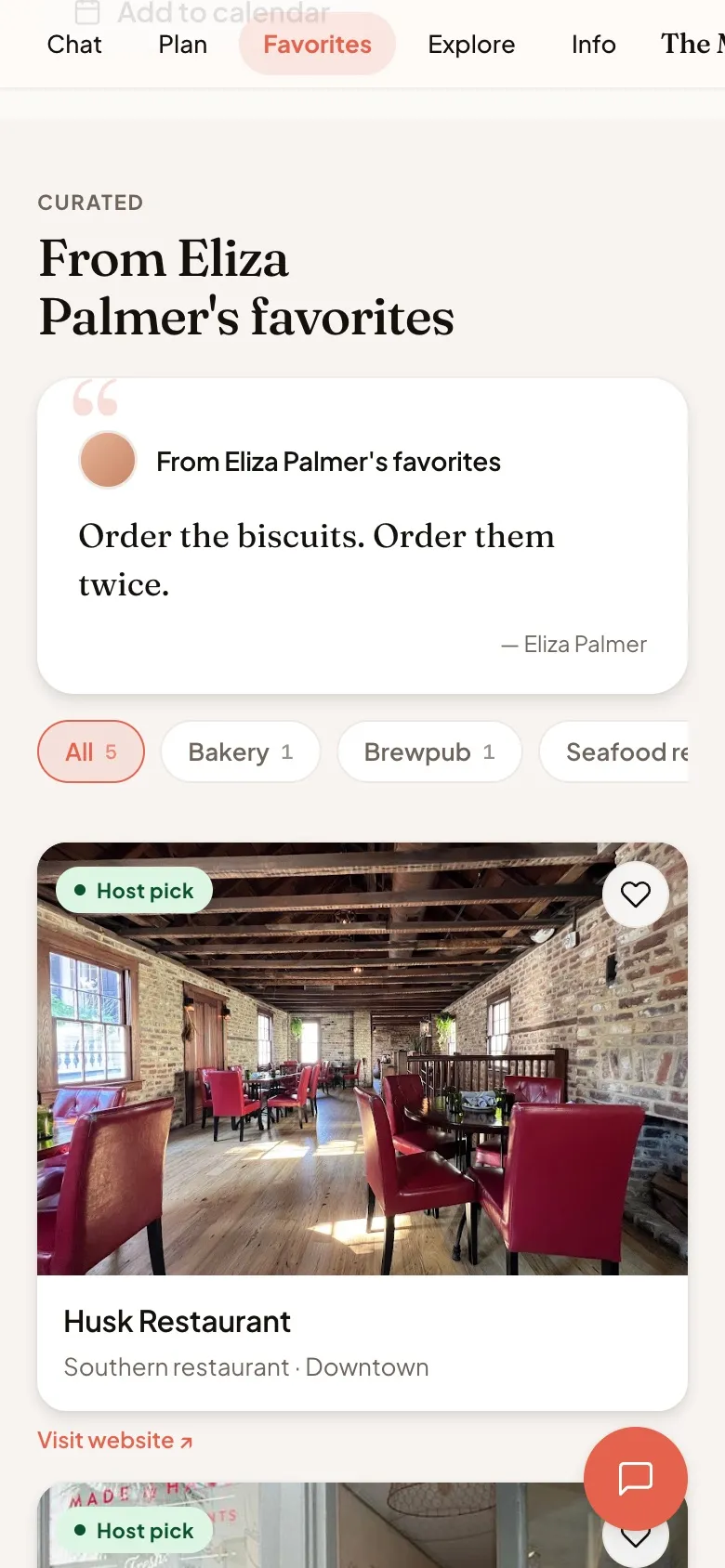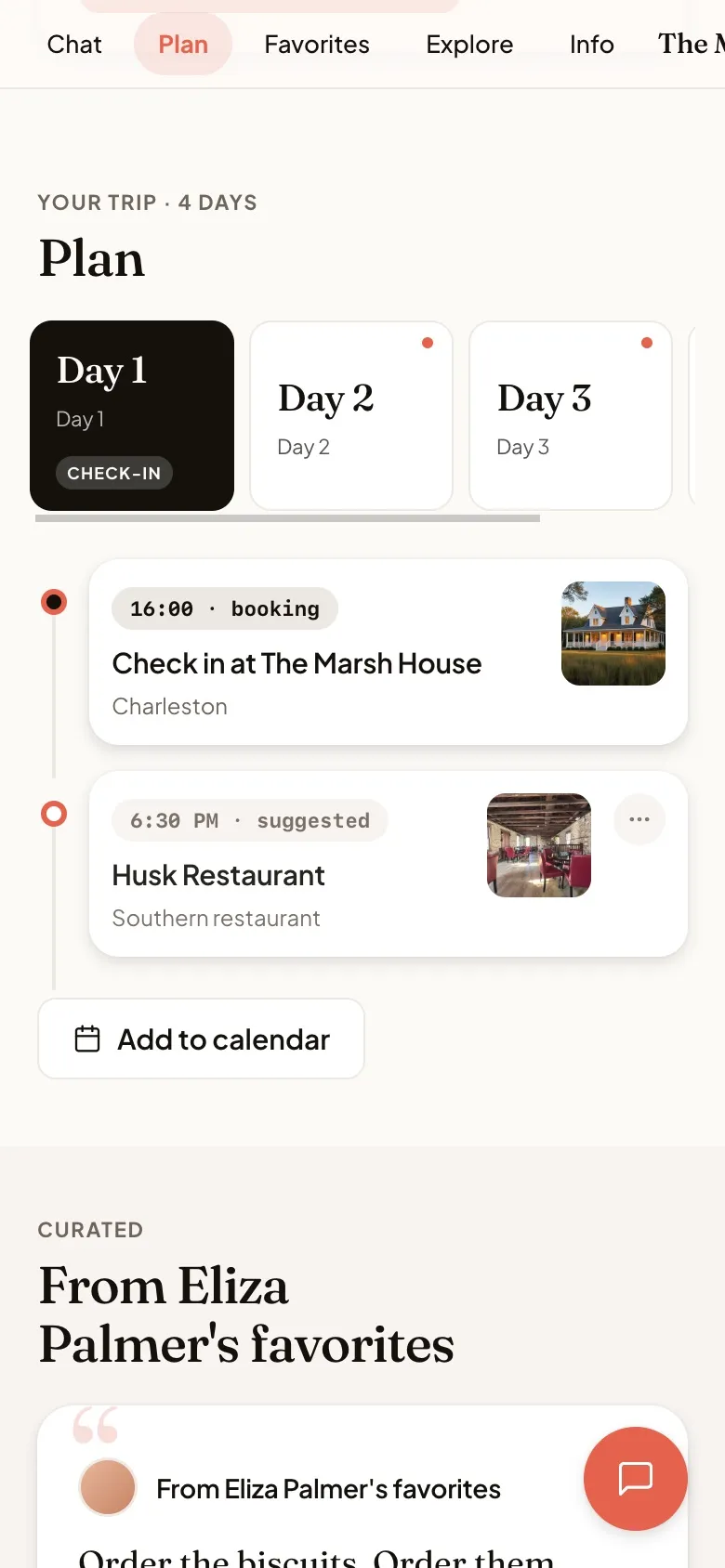
VIP Guest Guide gives each short-term rental a mobile web guide that guests open from a QR code or link, with no app and no account. An AI concierge answers in the host's voice, recommends the host's own favorites first, builds a day-by-day plan, and says plainly when it is working from the open web. Hosts set up properties, favorites, per-stay private links and billing in a dashboard, and AI agents can read the same guide through a hosted MCP server. The site, host sign-up and a sample guide are live.
The problem
Short-term rental guests ask their host the same questions again and again: the Wi-Fi, the door code, where to eat tonight. The usual answer is a welcome book. As the product’s own FAQ puts it, guests scroll a read-only document “then text you anyway.”
An AI chat could answer those questions, but a wrong restaurant or made-up opening hours does more harm than no answer. The guide also has to work in any town, not only where someone has curated the local spots.
What we built
Guests open one link or QR code on their phone. There is no app and no account. The guide is a single scrolling page with Chat, Plan, Favorites, Explore and house info. The concierge answers in the host’s voice, recommends the host’s favorites first, and labels each pick as a host pick, a “verify hours” or a web suggestion. Guests can save spots and build a day-by-day plan, then add it to their calendar.
Sensitive details like Wi-Fi and door codes can sit behind a private link for one stay. Hosts can connect a smart lock through Seam so each stay gets its own code, and import stays from a calendar feed.
Hosts run everything from a dashboard. A property wizard auto-saves and shows a live phone preview. “Add a place” fills in a favorite from Google Places. Hosts print QR codes as PDF, PNG or SVG, see guest engagement, and pay per property through Stripe.
A hosted MCP server lets AI agents read the same guide guests see, with OAuth 2.1 sign-in. An admin portal covers curated cities, billing and ops.
How we built it
The work started with a written constitution, ratified on April 19, 2026. It sets 8 principles every feature is checked against. Examples: the guide must never say “city not supported”, host favorites always rank above other content, and anything a guest can read must also be available as an MCP tool. It is now at version 2.3.0, and each change is logged with a reason.
Each feature then went through Spec Kit: a spec, a plan and a task list with tests ahead of the code. The repo holds 13 feature folders. Most of the code was written with Claude Code, and 258 of 317 commits are co-authored by Claude. One person merged all 103 pull requests.
The concierge is a custom tool loop on Claude. Chat runs on Haiku 4.5 and planning turns move up to Sonnet 4.6. The per-property part of the prompt is cached. Each property has a daily token budget. At 80% the concierge drops its city-search tool, and at 100% chat pauses until midnight UTC, so one busy guide can’t run up an open-ended bill.
CI runs typecheck, build and tests, then integration tests against a real database with a guard that fails if test data leaks into seed tables. Lighthouse checks the guest page’s accessibility. A smoke test hits the live API every hour.
What was hard
Keeping the AI honest. The model is never allowed to name a business in its own words. Every recommendation card must carry a listing ID returned by a tool call in that conversation, and the ID must still exist in the database. Otherwise the card doesn’t render. That rule exposed a serious bug. The streaming loop read tool calls from a field the raw stream events don’t carry, so in production no tool call ever ran. Because the model can’t name places without tools, replies just stopped. The fix read tool calls from the final assembled message and added tests that drive the loop with a realistic fake stream.
Tests that passed while the product didn’t work. The first feature’s retrospective lists 11 integration bugs found after the unit and contract tests were green. One example: the sign-in helper never created the host’s database row, so the first real property create would have failed. The mocks sat exactly where the real code broke. After that, the project added integration tests against a real database and end-to-end checks of real user flows.
Door codes and calendars. A review after the stay-access feature shipped found real gaps. Nothing was scheduling the jobs that create door codes or read calendar feeds. A wrong environment variable name broke guest verification in production. Another host could have taken over a lock. Date-only calendar events were read in the wrong time zone, so codes could expire hours before checkout. An empty calendar feed could have canceled every future stay. One pull request fixed all of them and added tests for each.
By the numbers
- 317 commits on main, from April 19 to November 7, 2026
- 103 merged pull requests, all merged by one person
- 258 commits co-authored by Claude
- 6 apps and 5 shared packages in one Turborepo
- 42 database models and 30 migrations
- 176 test files, including 9 Playwright end-to-end specs
- 11 concierge tools and 9 MCP tools
- 16 GitHub Actions workflows, including hourly and daily scheduled jobs
- About 62,000 lines of TypeScript outside tests
Where it is now
vipguestguide.com is live, and hosts can sign up at host.vipguestguide.com with a 14-day free trial. A sample guide runs the real concierge pipeline, pinned to the cheaper Haiku model with a fixed daily budget. The hosted MCP server at mcp.vipguestguide.com answers OAuth discovery requests.
The latest work, merged in November 2026, added a marketing research hub to the admin portal. It sits in the same GitHub organization as Levvn, and its deploy workflow follows the same pattern.